South Korean stocks and the won jumped on Monday as market participants cheered the Supreme Court decision on Trump’s tariffs. The USD/KRW dropped to 1,437, down by 2.6% from its highest point this year. Similarly, the Kospi Index moved close to the key resistance at KRW 6,000, with the popular Wyckoff Theory pointing to a retreat.
South Korean exports jump as chips demand soar
The Kospi Composite Index continued its strong surge on Monday after a report showed that South Korean exports continued their growth in February.
They jumped by 47.3% in the first 20 days of the month from a year earlier, driven by semiconductors. That increase was much higher than January’s 34%. Imports jumped by 11.7%, leading to a large trade surplus of $4.95 billion.
These numbers are important because the first 20 days included three Lunar New Year days. Semiconductor chips soared by 134%, while auto sales retreated by 27%, mostly because of US tariffs and competition from Chinese EV companies.
Soaring South Korean exports are bullish for the top chip companies, especially Samsung and SK Hynix. The two have become the biggest South Korean companies by far, with their market capitalization soaring to over $838 billion and $450 billion, respectively. Hyundai, the third-top company, has a valuation of over $81 billion.
The Kospi Index also soared as market participants reacted to the Supreme Court ruling on Donald Trump’s tariffs. The court ruled that the president did not have the power to impose those large tariffs.
Still, the president went ahead and applied a new global 15% tariff using existing laws. These tariffs will last for about 6 months, with an extension happening under congressional approval.
Trump will use those days to conduct investigations and apply more levies using other statutes. Still, the fact that the SCOTUS ruled that his use of emergency powers was illegal is a good thing for South Korea and other global stocks.
Most South Korean stocks jumped on Monday. Samsung shares rose by 1.85%, while SK Hynix jumped by 0.85%. Other top gainers were companies like Samsung Life Insurance, HD Hyundai Electric, Samsung Electro-Mechanics, and Hyosung Heavy Industries. LG Electronics soared by 10%.
The next major catalyst for the Kospi Index is the potential strike on Iran, which may lead to supply chains. It will also lead to higher crude oil prices, which will affect South Korea, a country that imports all its products.
Kospi Index technical analysis
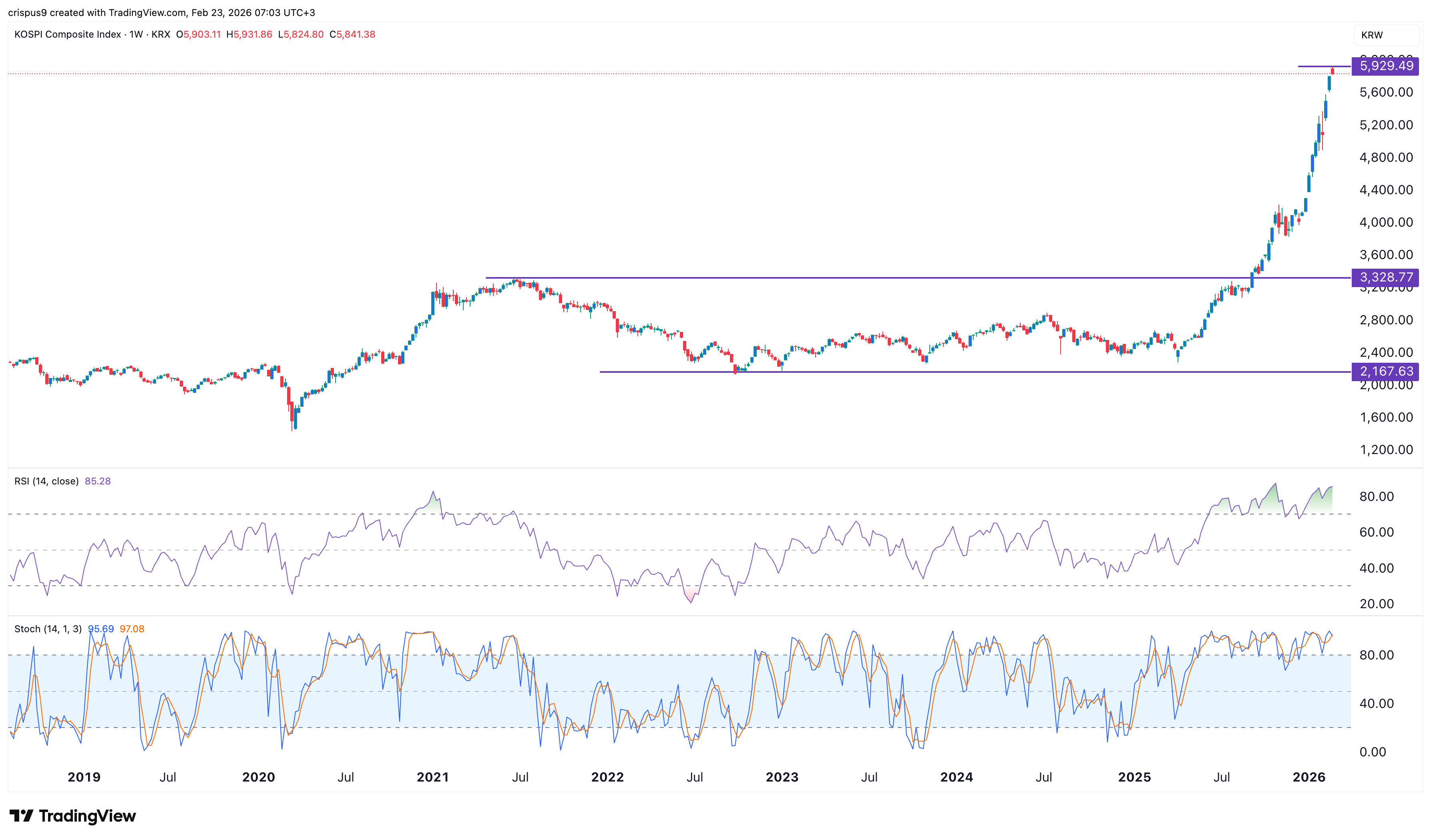
The weekly chart shows that the Kospi Index remained between the key support and resistance levels at KRW 2,167 and KRW 3,330 for years. This consolidation was part of the accumulation phase of the Wyckoff Theory.
It then moved to the markup phase, reaching its all-time high of KRW 5,930 on Monday. The markup phase is characterized by higher demand and Fear of Missing Out (FOMO).
Markup is then followed by the distribution and markdown. Therefore, there is a likelihood that the index will ultimately retreat as smart money starts selling.
This will happen now that the index has become highly overbought, with the Relative Strength Index soaring to over 80. Similarly, the Stochastic Oscillator has moved to the overbought level at nearly 100.
The post Kospi Index targets 6k as Wyckoff Theory points to a retreat appeared first on Invezz
